1990s to 2000s · Science & Technology
America COMPETES Act
Should the government bet taxpayer money on science and STEM education to keep America competitive?
Unlocked
Read lesson
Every Congressmon Bill Card is a real law. This is where you learn what happened after the vote.
A Bill Card tells you a law passed. The Big Book tells you why it mattered.
Should the government bet taxpayer money on science and STEM education to keep America competitive?
Free land for anyone willing to work it, and everyone left out of the deal.
How a 70 year fight rewrote who gets to vote in America.
The law that created NASA, and decided space exploration shouldn't belong to the military.
The law that ended legal segregation, and the coalition it took to pass it.
How Congress decided clean air was worth regulating, and who fought it.
Plus 44 more bills, unlocking as Congressmon gets closer to launch.
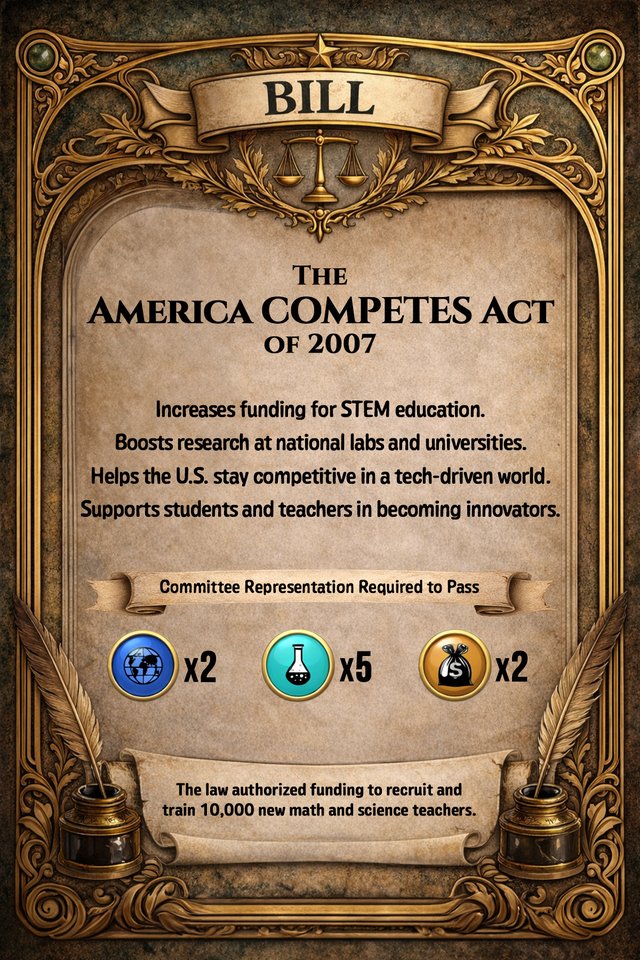
By the early 2000s, something was bothering scientists, universities, and business leaders alike: other countries were pouring money into science, technology, and engineering education, and the United States' long lead wasn't guaranteed to last. A widely read National Academies report, Rising Above the Gathering Storm, put the worry in stark terms, and Congress folded many of its recommendations into a bill.
That's the whole debate in one sentence. Everything below is Congress trying to answer it.
Learning objectives, by the end, students should be able to:
COMPETES wasn't one program. It was a bet placed in three places at once.
Major funding increases for the National Science Foundation, NIST, and the Department of Energy's Office of Science, the agencies that fund research most people never see happen.
Money for STEM teacher training and undergraduate science education, because a scientist has to be a student first. Education policy, treated as economic policy.
A new agency, modeled on the Pentagon's DARPA, built to fund energy ideas too risky for a private company to gamble on, but potentially transformative if they work.
Congress authorized $300 million for ARPA-E in its first year. That number sounds final. It isn't. Here's the distinction that trips up most adults, let alone students. Click the card to flip it.
Your parents say, "You can spend up to $50 on a jacket." That's permission to spend, up to a limit.
Now they actually hand you the money, maybe $50, maybe only $30. That's what you actually get to spend.
Permission to spend money is not the same as spending it. With COMPETES, actual funding often landed below what was authorized. Passing a law doesn't guarantee every line in it happens exactly as written.
Give the class this scenario: Congress has an extra $1 billion. You must decide what to do with it. Have students pick one and defend it: science labs, STEM teacher training, incentives for tech companies, or just paying down debt.
Then raise the stakes: what if the investment won't show results for 10 to 20 years? Does anyone change their answer?
Split students into small "Congressional committees." Each gets $100 billion to spend across six categories. Every dollar spent one place is a dollar that can't go anywhere else. Try it yourself below.
Present both sides as genuine philosophies, not a right answer and a wrong one.
Discussion question: where should government investment end and private investment begin? There isn't one required answer. Students have to defend theirs.
This section plays well as a quick Family Feud style round. Split the class into a "For" team and an "Against" team. Before revealing the lists above, ask each team to shout out as many reasons as they can for their side in 60 seconds. Award a point for every answer that matches something on the board, and a bonus point if they name one you hadn't listed but can defend. It turns a two sided debate into something closer to a game, and it tends to pull in the students who go quiet during open discussion.
2007 isn't ancient history. The industries COMPETES tried to strengthen are the ones students already hear about constantly:
COMPETES didn't invent any of these industries by itself. That's the real question worth asking: can students tell the difference between government funding causing a breakthrough and government funding simply helping create the conditions where one became possible?
Back to the game. You passed the America COMPETES Act. But legislation isn't the end of the story. Congress still has to fund it, agencies have to run it, and future Congresses can change it all again.
The Bill Card is the vote. The Big Book of Bills is what happens after it.
Join the Congressmon waitlist and we'll let you know the moment new lessons, and the game itself, are ready.
Join the waitlist